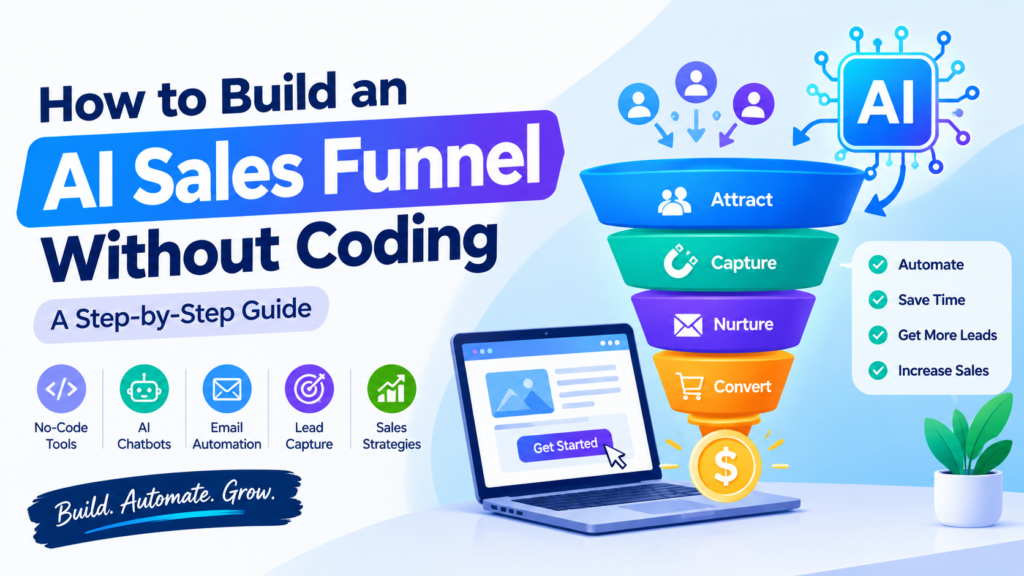

How to Build an AI Sales Funnel Without Coding
In the past, building a sales funnel required technical skills, expensive software, and sometimes a developer. Today, however, AI-powered tools make it possible to build an AI sales funnel without coding and automate many parts of the customer journey.
Whether you run an online business, sell digital products, offer services, or generate leads, an AI sales funnel can help you attract visitors, capture leads, nurture prospects, and convert them into customers.
In this guide, you’ll learn how to build an AI sales funnel without coding, what tools you need, and how to automate the process step by step.
What Is an AI Sales Funnel Without Coding?
An AI sales funnel is a customer journey that uses artificial intelligence to automate or improve different stages of the sales process. A traditional funnel typically includes:
- Attracting visitors
- Capturing leads
- Building relationships
- Presenting an offer
- Converting visitors into customers
AI can take on much of this work — generating landing page content, answering customer questions, qualifying leads, personalizing messages, and automating follow-up emails. The goal isn’t to replace your marketing strategy with AI; it’s to use AI to save time and make your existing funnel more efficient.
How Does an AI Sales Funnel Without Coding Work?
Yes. No-code platforms now let you build landing pages, forms, email sequences, chatbots, automations, and even payment flows using simple drag-and-drop visual editors.
A basic no-code AI sales funnel looks something like this:
Traffic → Landing Page → Lead Capture → AI Follow-Up → Offer → Purchase
You connect each of these steps using no-code automation tools instead of custom code.
1. Choose Your Target Audience
First, before building anything, get specific about who you’re trying to reach. For example, your audience might be:
- Small business owners
- Freelancers
- E-commerce businesses
- Digital product creators
- Coaches and consultants
- Affiliate marketers
2. Create a Valuable Offer
Next, every funnel needs a reason for visitors to act. Your offer could be a digital product, an online course, a consultation, a software subscription, a free guide, a product recommendation, or a free trial.
For example, for lead-generation funnels, a free resource in exchange for an email address works well:
Free AI Marketing Checklist → Email Signup → Automated Follow-Up → Product Recommendation
3. Build an AI Sales Funnel Landing Page
After that, your landing page becomes the first real impression visitors get. AI tools can help you generate headlines, product descriptions, benefit statements, calls to action, and FAQ sections.
Moreover, keep it focused. A landing page with one clear goal can perform better than one with too many options. For example, a simple structure to follow is:
Headline → Problem → Solution → Benefits → Social Proof → CTA
4. Add a Lead Capture Form
Next, if lead generation is the goal, keep your form short — usually just name and email. In addition, every extra field you add can give someone another reason to abandon it. Therefore, pair the form with a clear CTA like “Get the Free Guide” or “Start Your Free Trial.”
5. Add an AI Chatbot to Your Sales Funnel
Meanwhile, an AI chatbot lets visitors get instant answers without waiting on a human. For example, it can handle common questions about pricing, features, benefits, and delivery. It can handle common questions about pricing, features, benefits, and delivery, and even help qualify leads by asking what they’re looking for. Just make sure it gives accurate information and offers an easy path to a human when needed.
Speaking of which — if you have questions about your own funnel while reading this, don’t hesitate to reach out and talk to me directly. I’m happy to help.
6. Automate AI Sales Funnel Follow-Up Emails
However, most people won’t buy the first time they see your offer. Therefore, automated follow-up emails can help build trust and keep your offer in front of potential customers.
- First, deliver the free resource
- Next, explain the customer’s problem
- Then, provide useful tips
- After that, introduce your solution
- Finally, invite the customer to take action
Additionally, AI can help brainstorm topics and draft variations. However, always review AI-generated emails before they go out to your audience.
7. Connect Your Tools With Automation
Next, link everything together:
Landing Page → Form → Email Platform → CRM → AI Automation
As a result, when someone submits your form, automation can instantly save the lead, add them to an email list, send a welcome email, notify your team, and kick off the follow-up sequence — no manual work, no code.
8. Present Your Sales Offer
Once leads are warmed up, it’s time for the main offer. At this stage, your sales page should clearly cover what you’re offering, who it’s for, what problem it solves, key benefits, pricing, FAQs, and how to get started. Finally, keep the call to action consistent throughout.
9. Test and Optimize
Finally, your first version won’t be perfect, and that’s fine. Instead, test headlines, CTA buttons, layouts, forms, subject lines, offers, and follow-up sequences. Test headlines, CTA buttons, layouts, forms, subject lines, offers, and follow-up sequences. Track movement through each stage:
Visitors → Leads → Qualified Leads → Customers
As a result, you can find out exactly where people are dropping off and fix those areas.
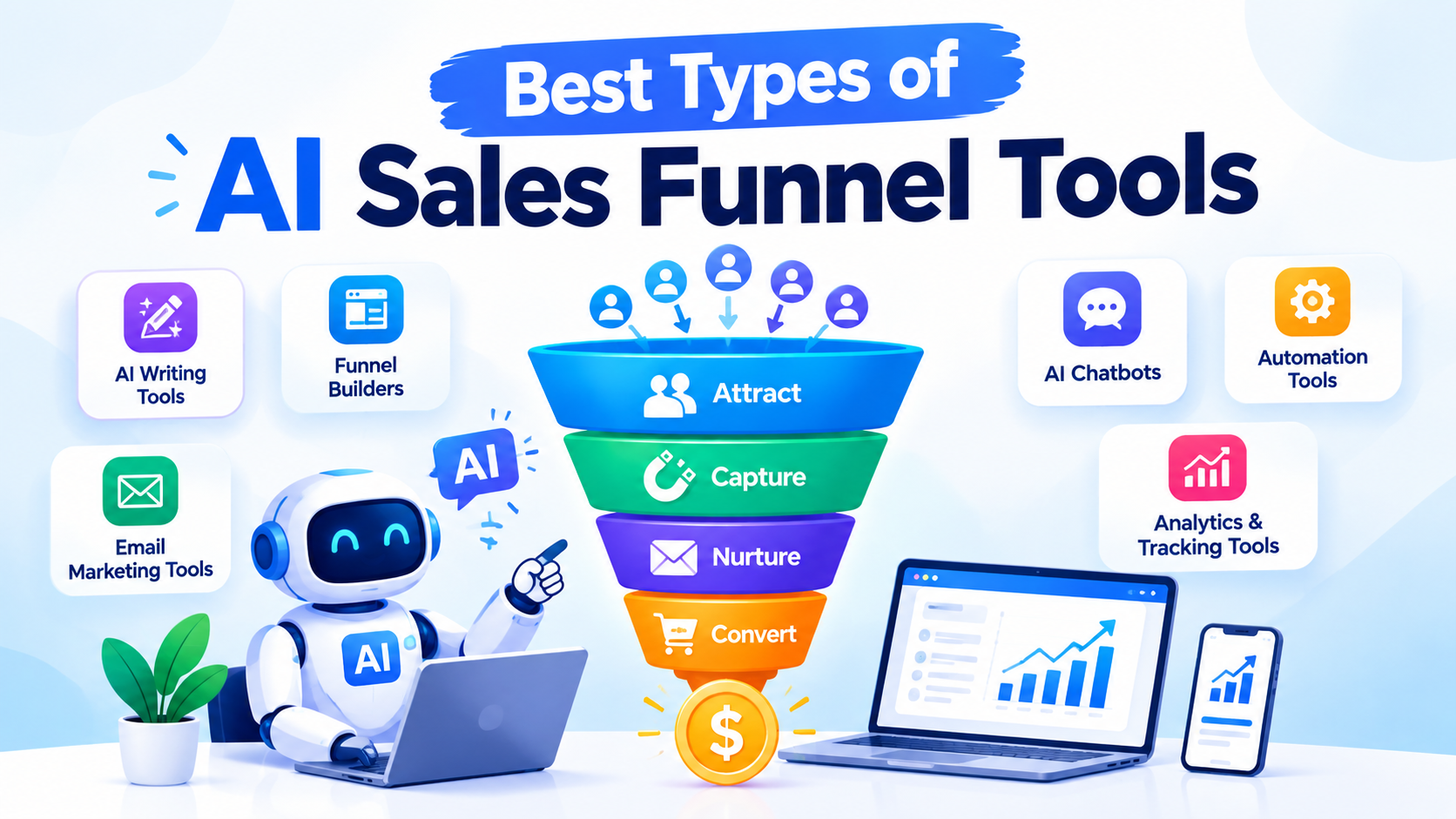
Best AI Sales Funnel Tools for Automation
You don’t need dozens of tools — just the right few for your model and budget:
- AI writing tools for blog content, landing page copy, email drafts, ad copy, and product descriptions
- Funnel builders for landing pages, forms, and sales pages via visual editors
- Email marketing platforms for automated sequences and lead management
- AI chatbots for answering questions and qualifying leads
- Automation tools :You can use automation platforms like Zapier to connect your marketing tools and automate repetitive tasks.
Start with the minimum toolset needed to run your funnel, then add more as you scale.
AI Sales Funnel vs. Traditional Sales Funnel
The core difference is automation. A traditional funnel demands more manual effort for content creation, lead qualification, support, and follow-up. An AI-powered funnel automates or assists with most of that.
That said, AI doesn’t guarantee sales on its own. Your offer, audience, messaging, traffic quality, and overall customer experience still do the heavy lifting.
Common Mistakes to Avoid
- Using too many AI tools — more platforms often mean more complexity and cost, not better results.
- Focusing only on AI — AI is a tool, not a strategy. Start with your customer’s problem, not the technology.
- Creating generic content — unedited AI output can feel repetitive. Add your own voice, examples, and experience.
- Ignoring analytics — without tracking, you’re guessing which parts of your funnel actually work.
- Overcomplicating the funnel — simpler funnels are easier to manage, test, and improve.
Final Thoughts
You don’t need to be a developer to build an AI sales funnel without coding. Modern no-code platforms and AI tools make it possible to create landing pages, capture leads, automate follow-ups, answer customer questions, and guide prospects toward a purchase — all on your own.
Overall, start small: choose one audience, create one clear offer, build a simple funnel, and automate the repetitive parts. Then, improve your funnel based on real results.
Need Help? Let’s Talk {#lets-talk}
Reading about funnels is one thing — building one that actually converts is another. If you’d like a second opinion on your setup, help choosing the right tools, or a hand building the whole thing from scratch, I’m here for it.
📩 [Send me a message] — tell me a bit about your business and what you’re trying to achieve. 💬 [Chat with me live] — got a quick question? Ask it directly, no form required. 📅 [Book a free call] — if you’d rather talk it through, grab a time that works for you.
No pressure, no sales pitch — just a real conversation about what would actually help your funnel perform better.
Frequently Asked Questions
What is an AI sales funnel? An AI sales funnel uses artificial intelligence to assist or automate different stages of the customer journey — lead generation, customer support, follow-ups, and sales.
Can I build an AI sales funnel without coding? Yes. No-code funnel builders, email platforms, chatbot tools, and automation platforms let you build AI-powered funnels without any programming.
What is the best AI funnel builder? It depends on your budget, business model, required features, integrations, and level of automation you need. Compare a few options before committing.
Is an AI sales funnel suitable for beginners? Yes. Start with a simple landing page, lead form, email sequence, and automation, then add more advanced AI features as your business grows.
How much does it cost to build an AI sales funnel?
It depends entirely on the tools you choose — many platforms offer free plans, while more advanced funnel builders, email tools, and automation services come with paid subscriptions.