
AI Marketing Tools for Small Businesses: What Actually Works in 2026
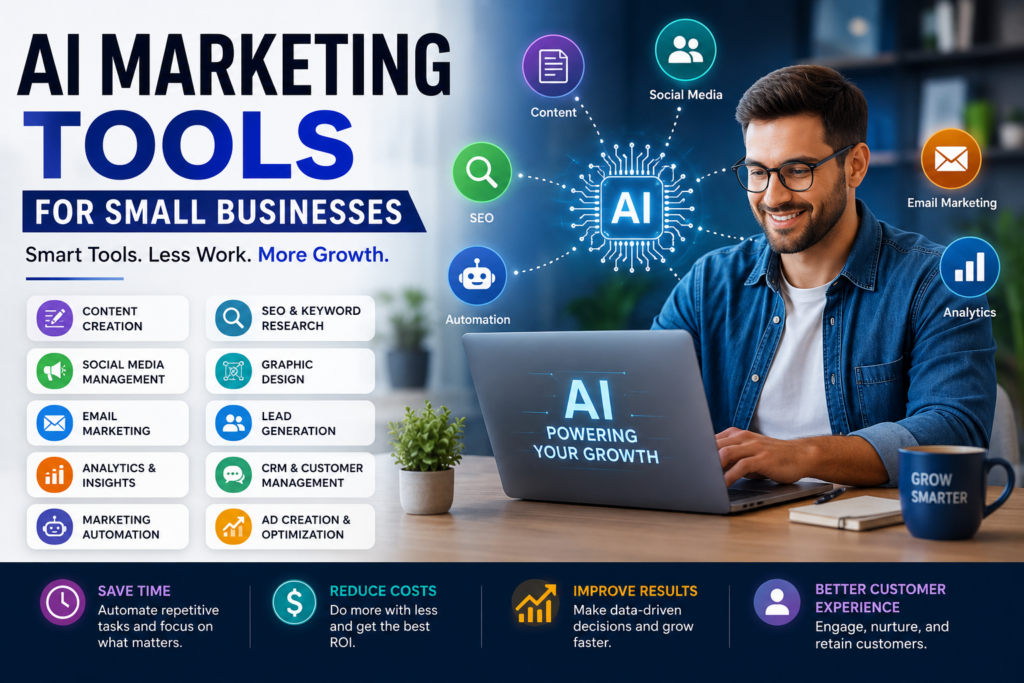
AI marketing tools for small businesses can help entrepreneurs save time, reduce marketing costs, and reach more customers.
If you run a small business, you already know the problem. Unfortunately, there’s never enough time, the marketing budget is tight, and you’re expected to write blog posts, manage social media, run email campaigns, chase leads, and somehow still keep an eye on SEO, while also doing the actual job that pays the bills.
This is where AI marketing tools for small businesses have become genuinely useful. However, they won’t replace your judgment, your relationships with customers, or your understanding of what makes your business different. Instead, they can take care of repetitive, time-consuming marketing tasks, such as drafting content, scheduling posts, organizing leads, and checking keywords. As a result, you can spend more of your limited hours on strategy and less on busywork.
This guide is not a hype piece.To be clear, no honest tool guarantees instant sales or search rankings. Therefore, this guide will not make fake promises. However, it gives you a clear look at which tools are truly effective. In addition, it helps you identify their limitations so you can avoid wasting money on unused subscriptions.
Quick Answer: Editor’s Pick for Best AI Marketing Tools for Small Businesses
If you only read one section, read this one.
- Best all-in-one pick: HubSpot — combines CRM, email, and AI content tools in one place.
- Best for writing on-brand content: Jasper.
- Best free, general-purpose assistant: ChatGPT.
- Best for sales copy and social captions: Copy.ai.
- Best for design without a designer: Canva.
- Best for SEO content optimization: Surfer SEO.
- Best for full-picture SEO and competitor research: Semrush AI Toolkit.
- Best for email marketing automation: Mailchimp.
- Best for social media scheduling: Buffer.
- Best for connecting tools and automating workflows: Zapier.
However, none of these tools is “the best” in isolation. Instead, the right pick depends on where your marketing is actually falling short right now.
Quick Comparison: Best AI Marketing Tools for Small Businesses
| AI Marketing Tool | Best For | Beginner Friendly | Main Use |
| ChatGPT | Content & marketing ideas | ⭐⭐⭐⭐⭐ | Writing, research, strategy |
| Canva | Graphics & social posts | ⭐⭐⭐⭐⭐ | Design and visual content |
| HubSpot | CRM & automation | ⭐⭐⭐⭐ | Leads, email, customer management |
| Semrush | SEO & competitor research | ⭐⭐⭐ | Keywords and SEO |
| Buffer | Social media | ⭐⭐⭐⭐⭐ | Scheduling and publishing |
| Mailchimp | Email marketing | ⭐⭐⭐⭐ | Newsletters and campaigns |
| Jasper | Marketing content | ⭐⭐⭐⭐ | Brand-focused copywriting |
| Zapier | Marketing automation | ⭐⭐⭐⭐ | Connecting apps and workflows |
| Surfer SEO | SEO content optimization | ⭐⭐⭐⭐ | Content optimization |
| AdCreative.ai | Ad creatives | ⭐⭐⭐⭐ | Advertising images and copy |
What Are AI Marketing Tools for Small Businesses?
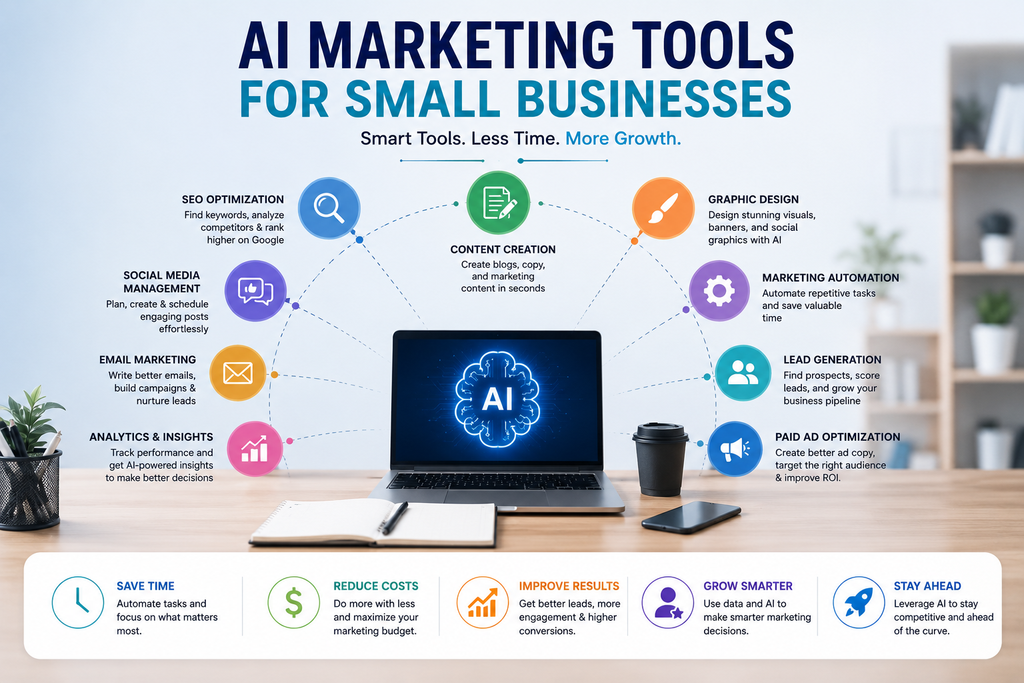
AI marketing tools for small businesses are software platforms that use artificial intelligence to help entrepreneurs complete marketing tasks faster. For example, they can assist with content creation, SEO, social media, email marketing, and customer communication.
Depending on the platform, AI can help with:
- Blog writing and content ideas
- Keyword research
- Social media captions
- Email campaigns
- Graphic design
- Lead management
- Customer follow-up
- Marketing automation
- Competitor research
- Advertising creatives
- Content optimization
For a small business, the biggest advantage isn’t simply “using AI.” Instead, the main benefit is saving time while maintaining a consistent marketing process. Therefore, business owners can focus more on strategy rather than repetitive daily tasks.
Top 10 AI Marketing Tools for Small Businesses Reviewed
1. ChatGPT — Best AI Marketing Tool for Content and Strategy
Indeed, if you’re looking for a flexible AI marketing assistant, ChatGPT is one of the easiest options to consider. In fact, it can help your small business with many different tasks. For example, you can use it to generate content ideas and draft social media captions. Furthermore, it is great for writing emails as well as creating complete marketing plans.
In addition, small businesses can use it to brainstorm blog topics as well as create structured content outlines. Furthermore, it helps you write social media captions and generate engaging email ideas. In fact, you can also research new marketing angles, answer customer FAQs, and develop complete marketing plans effortlessly.
What ChatGPT Can Help With
- Blog topic ideas
- Content outlines
- Social media captions
- Email copy
- Marketing strategies
- Product descriptions
- Customer FAQs
- Ad copy ideas
- Video scripts
- Content repurposing
Best For: Solo entrepreneurs, bloggers, freelancers, affiliate marketers, and small marketing teams.
One Limitation: AI-generated content still needs human review. A good marketing strategy requires accurate information, brand knowledge, original ideas, and real customer understanding.
Our verdict: ⭐⭐⭐⭐⭐
2. Canva — Best Visual AI Marketing Tool for Small Businesses
Fortunately, you don’t need to be a professional graphic designer to create attractive marketing materials anymore. In addition, Canva makes it easier for small businesses to create professional-looking designs with less time and effort.
Canva combines easy-to-use design tools with AI-powered features that can help small businesses create social media graphics, presentations, advertisements, thumbnails, banners, and other marketing assets. For instance, businesses can create several types of promotional content without hiring a designer for every task.
What Canva Is Useful For
- Instagram posts
- Facebook graphics
- YouTube thumbnails
- Blog images
- Advertisements
- Presentations
- Promotional banners
- Marketing materials
Therefore, Canva can be extremely useful for a small business owner who needs professional-looking graphics without hiring a designer for every task.
Best For: Small businesses, creators, bloggers, ecommerce stores, and social media marketers.
One Limitation: Templates can sometimes make different brands look similar, so customizing your colors, fonts, images, and messaging is important.
Our verdict: ⭐⭐⭐⭐⭐
3. HubSpot — Best AI Marketing Tool for CRM and Automation
Marketing isn’t only about getting visitors. In addition, you need a system for managing leads and customers. Therefore, having a reliable CRM can become increasingly important as your business grows.
HubSpot combines CRM, marketing, sales, customer service, and automation features. Furthermore, its AI capabilities can assist with tasks such as content creation, customer information, and marketing workflows. Therefore, it can be useful for businesses that want to manage several marketing activities in one place.
What HubSpot Can Help With
- Managing leads
- Customer relationship management
- Email marketing
- Marketing automation
- Sales pipelines
- Customer communication
- Reporting
- Campaign management
Best For: Small businesses that are starting to generate regular leads and need better customer management.
One Limitation: HubSpot can become more complex as your business grows, and some advanced capabilities are available only on paid plans.
Our verdict: ⭐⭐⭐⭐½
4. Semrush — Best AI Tool for SEO and Keyword Research
If your goal is to get more visitors from Google, SEO should be part of your marketing strategy. For example, Semrush can help you research keywords, analyze competitors, and discover new SEO opportunities.
Semrush provides tools for keyword research, competitor analysis, SEO, content, and website performance. For example, a small business can research what people search for before creating a blog post. In addition, competitor research can reveal useful SEO opportunities.
What Semrush Can Help With
- Keyword research
- Competitor analysis
- SEO audits
- Content research
- Backlink analysis
- Search visibility
- Website SEO
Best For: Businesses that want to build long-term organic traffic from search engines.
One Limitation: Semrush has a large number of features, which can feel overwhelming for complete beginners.
Our verdict: ⭐⭐⭐⭐½
5. Buffer — Best AI Tool for Social Media Marketing
However, maintaining social media consistency can be difficult when you’re running a business. Fortunately, Buffer can make this process easier by helping you plan and schedule content in advance.
Buffer helps businesses plan and schedule social media content. Its AI-related features can also assist with creating or improving social media content. Instead of manually publishing every post, you can prepare content ahead of time and schedule it.
What Buffer Is Useful For
- Social media scheduling
- Content planning
- Social captions
- Publishing
- Managing multiple social channels
- Social media analytics
Best For: Small businesses that want a simple social media workflow.
One Limitation: Scheduling posts doesn’t automatically create engagement. You still need useful content and interaction with your audience.
Our verdict: ⭐⭐⭐⭐½
6. Mailchimp — Best AI Tool for Email Marketing Automation
Moreover, email marketing remains an important way to turn visitors into returning customers.
Mailchimp provides tools for email campaigns, newsletters, audience management, automation, and marketing. In addition, AI-assisted features can help marketers work faster when creating email content and campaigns.
What Mailchimp Can Help With
- Email newsletters
- Promotional emails
- Customer follow-ups
- Email automation
- Audience management
- Campaign creation
Best For: Small businesses building an email subscriber list.
One Limitation: Your results depend heavily on the quality of your email list, offer, subject lines, and content.
Our verdict: ⭐⭐⭐⭐
7. Jasper — Best AI Marketing Tool for Brand Content
However, businesses that publish a large amount of marketing content may need more than a general AI chatbot. In that case, a marketing-focused platform such as Jasper can provide additional content and brand-focused features.
Furthermore, Jasper is designed specifically around marketing and content workflows, making it useful for teams that need consistent brand messaging across multiple marketing channels.
What Jasper Can Help With
- Marketing copy
- Blog content
- Advertising copy
- Social media content
- Brand messaging
- Campaign content
Best For: Marketing teams and businesses producing content at scale.
One Limitation: For a very small business with a limited marketing budget, a general AI assistant may provide enough functionality without adding another subscription.
Our verdict: ⭐⭐⭐⭐
8. Zapier — Best AI Tool for Marketing Automation Workflows
One of the biggest problems for small businesses is repetitive work. For example, a customer may fill out a form, the lead is added to a system, an email is sent, and the sales team receives a notification.
As a result, Zapier can connect different applications and automate workflows like these.
What Zapier Can Help Automate
- Lead collection
- Email notifications
- Customer follow-ups
- Form submissions
- CRM updates
- Marketing workflows
- Data transfers between apps
Best For: Businesses that use multiple marketing applications and want them to work together.
One Limitation: Automation can become complicated when you build advanced workflows, so it’s better to start with simple automations.
Our verdict: ⭐⭐⭐⭐½
9. Surfer SEO — Best AI Tool for Content Optimization
Writing an article is only part of SEO. In addition, you need to make sure your content covers the topic properly and is structured in a way that is useful for searchers. Therefore, content optimization can be an important part of an effective SEO strategy.
Moreover, Surfer SEO focuses on content optimization and can help writers analyze and improve content for search visibility.
What Surfer SEO Can Help With
- Content optimization
- Keyword usage
- Content structure
- SEO recommendations
- Topic coverage
- Content improvement
Best For: Bloggers, content marketers, affiliate websites, and businesses investing in organic search.
Although SEO tools provide valuable recommendations, they cannot guarantee that a page will rank on Google. In fact, one major limitation is that ranking ultimately depends on Google’s algorithm.
Our verdict: ⭐⭐⭐⭐
10. AdCreative.ai — Best AI Marketing Tool for Ad Creatives
However, for many small businesses, creating advertising creatives can take a lot of time.
Furthermore, AdCreative.ai focuses on generating advertising-related visuals and copy that businesses can use when testing paid campaigns.
This can be useful for businesses that regularly create multiple advertising variations.
What AdCreative.ai Is Useful For
- Ad creatives
- Social media advertisements
- Marketing visuals
- Ad copy
- Creative testing
Best For: Small businesses actively running paid advertising campaigns.
One Limitation: A good-looking advertisement doesn’t guarantee conversions. Targeting, offer, landing page, budget, and audience quality still matter.
Our verdict: ⭐⭐⭐⭐
Which AI Marketing Tools for Small Businesses Should You Choose?
There isn’t one perfect AI marketing tool for every business. Instead, the right choice depends on your biggest marketing problem. For example, a business focused on SEO may need a different tool than one focused on social media.
- If You Need Content: Start with ChatGPT.
- If You Need Better Graphics: Try Canva.
- If You Need SEO Traffic: Look at Semrush or Surfer SEO.
- If You Need Social Media Scheduling: Consider Buffer.
- If You Need Email Marketing: Consider Mailchimp.
- If You Need Customer and Lead Management: Consider HubSpot.
- If You Need Marketing Automation: Consider Zapier.
- If You Need Advertising Creatives: Consider AdCreative.ai.
How to Build the Best AI Marketing Stack for Small Businesses
You don’t need ten different subscriptions. In fact, buying too many tools can make marketing more complicated instead of easier. Instead, start with the tools that solve your biggest marketing problems. You don’t need ten different subscriptions. In fact, buying too many tools can make marketing more complicated instead of easier. Instead, start with the tools that solve your biggest marketing problems. Then, add another tool only when you actually need it.
A simple starting workflow could look like this:
- Step 1: Use ChatGPT for ideas and content planning.
- Step 2: Use Canva to create attractive visuals.
- Step 3: Use Semrush or another SEO platform to research search opportunities.
- Step 4: Publish useful content on your website.
- Step 5: Use Buffer to distribute content through social media.
- Step 6: Use Mailchimp to build an email audience.
- Step 7: Use HubSpot or Zapier when your lead and customer workflow becomes more advanced.
Overall, this approach allows a small business to build a marketing system gradually. As a result, you can avoid buying every tool at once and focus on the software that provides real value.
Are AI Marketing Tools for Small Businesses Really Worth It?
Yes, but AI marketing tools are worth using only when they’re solving a real business problem. Therefore, businesses should choose tools based on their actual marketing needs rather than popularity.
Overall, recent 2026 comparisons point toward a similar lesson: the best tool isn’t necessarily the one with the most AI features. Instead, it is the one that removes a meaningful bottleneck in your marketing workflow.
For example:
- If you spend five hours every week creating social media graphics, a design tool like Canva may provide more value than an SEO platform.
- If your website isn’t attracting search traffic, SEO research with Semrush or Surfer SEO may be a higher priority.
- If you’re losing leads because nobody follows up quickly, CRM and automation via HubSpot or Zapier may provide a bigger improvement.
For this reason, choose the problem first, and then choose the AI tool that best solves it.
Common Mistakes to Avoid When Using AI Marketing Tools for Small Businesses
1. Buying Too Many Tools
More software doesn’t automatically mean better marketing. Instead, start with one or two tools that solve your biggest problems. Then, add another tool only when there is a clear reason to do so.
2. Publishing AI Content Without Editing
AI can save time. However, blindly publishing generic content can make your website less useful. Therefore, always review the content and add your own insights, examples, and recommendations. Always add:
- Original insights
- Real examples
- Personal experience
- Useful screenshots
- Expert commentary
- Clear recommendations
3. Expecting Instant Google Traffic
SEO is a long-term strategy. Therefore, a new article does not automatically rank just because it was written with AI. Instead, focus on helpful content, relevant search intent, strong internal linking, and consistent publishing. As a result, your content can provide more value to both readers and search engines.
4. Automating Everything
Automation is useful, but human judgment still matters. For this reason, AI should help you work faster rather than remove your responsibility for checking accuracy, quality, and brand voice. Ultimately, human review remains important for maintaining quality and accuracy.
Frequently Asked Questions About AI Marketing Tools for Small Businesses
What are the best AI marketing tools for small businesses?
Overall, it depends on the need, but strong all-around picks include HubSpot for CRM and marketing, ChatGPT or Jasper for content, Canva for design, and Buffer or Mailchimp for social and email.
What is the best free AI marketing tool for small businesses?
ChatGPT’s free tier is one of the most broadly useful starting points, alongside Canva’s free plan for design and HubSpot’s free CRM.
Can AI replace a small business marketing team?
No. AI can speed up drafting, scheduling, and research. However, it still needs human strategy, judgment, and fact-checking behind it. Therefore, businesses should use AI as a supporting tool rather than a complete replacement for human decision-making.
Are AI marketing tools for small businesses really worth it?
In fact, for most businesses, the answer is yes — especially for time-consuming tasks like content drafting and scheduling. However, the true value depends on actually using the tool consistently, not just subscribing to it.
How can AI help a small business get more customers?
For example, AI tools can speed up content creation, improve SEO targeting, personalize email follow-ups, and automate lead capture. As a result, these tools can support customer growth indirectly, without guaranteeing specific results.
Which AI tool is best for social media marketing?
For example, Buffer is a solid, beginner-friendly pick for scheduling and captions, while Canva handles the visual side well.
Which AI tool is best for SEO?
Surfer SEO is strong for optimizing individual pieces of content, while Semrush AI Toolkit is better suited to broader SEO strategy and competitor research.
How many AI marketing tools does a small business need?
Most small businesses do fine with three to five tools covering content, design, and one distribution channel (social or email) — not all ten covered in this guide.
Final Verdict: Choosing the Right AI Marketing Tools for Small Businesses
Indeed, there is no single “best” AI marketing tool for every small business. Instead, the right pick depends on where your marketing is actually breaking down. For example, a service business drowning in follow-ups probably needs a CRM with automation more than another writing tool. Similarly, a retailer with no design help may get more value from Canva than from an SEO platform they will rarely use.
Ultimately, what matters more than which tools you pick is how you use them.
First, start with one tool and use it consistently for a reasonable period. Then, add another tool only when the first one has earned its place. AI marketing tools for small businesses are genuinely useful when treated as an assistant to your strategy — not a replacement for it.
If you’re just getting started, pick the one tool from this guide that matches your biggest current bottleneck, try its free plan or trial, and see how it fits into your actual week before adding anything else.